

If your business owns a vehicle; a delivery van, a work ute, a company sedan, or an SUV beware. The Australian Taxation Office (“ATO”) is currently running a targeted compliance campaign with the assistance of a data-matching with the Roads Authorities that will certainly put you in its sights. Thousands of businesses have already received letters with the ATO advising that more are to come.
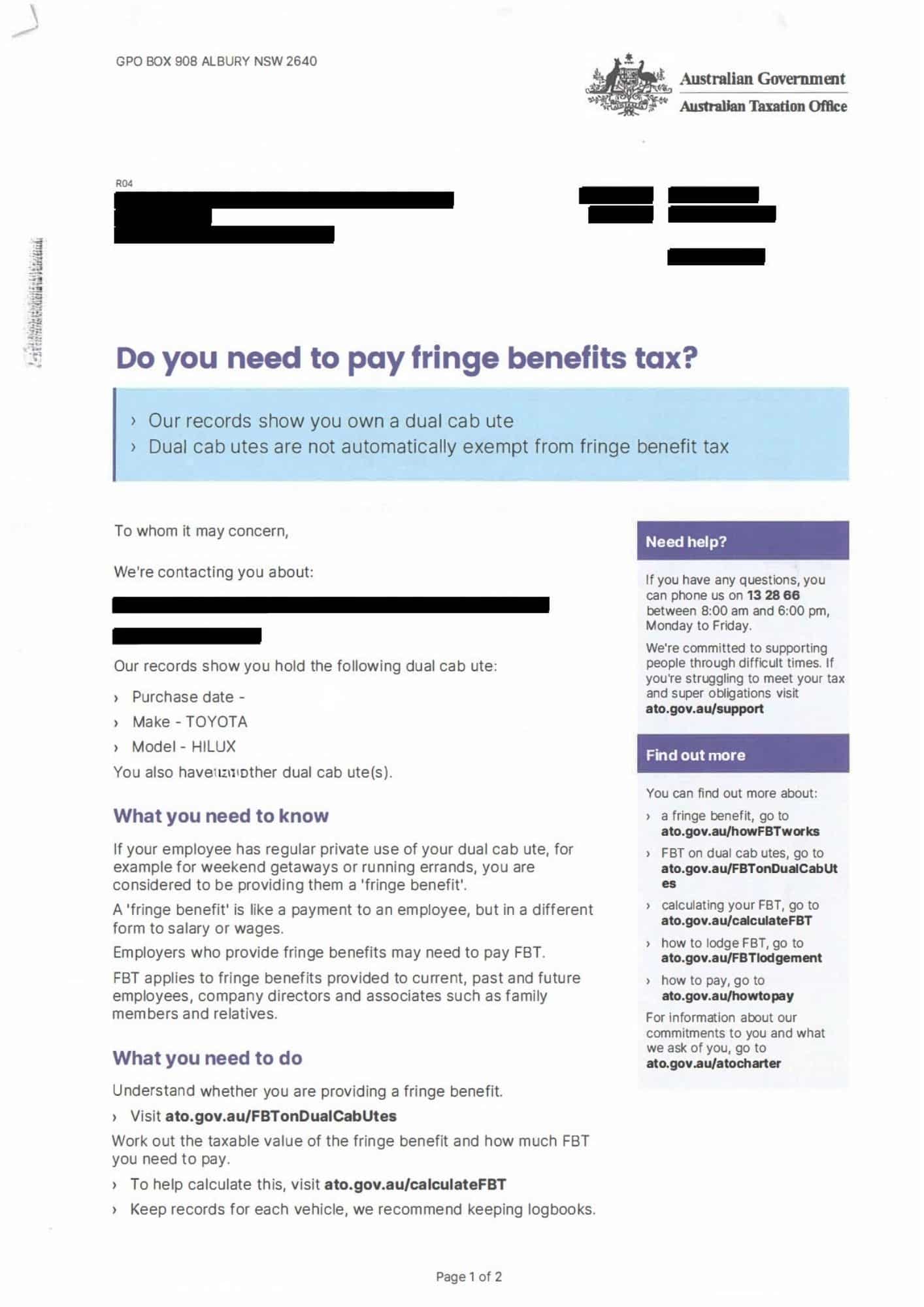
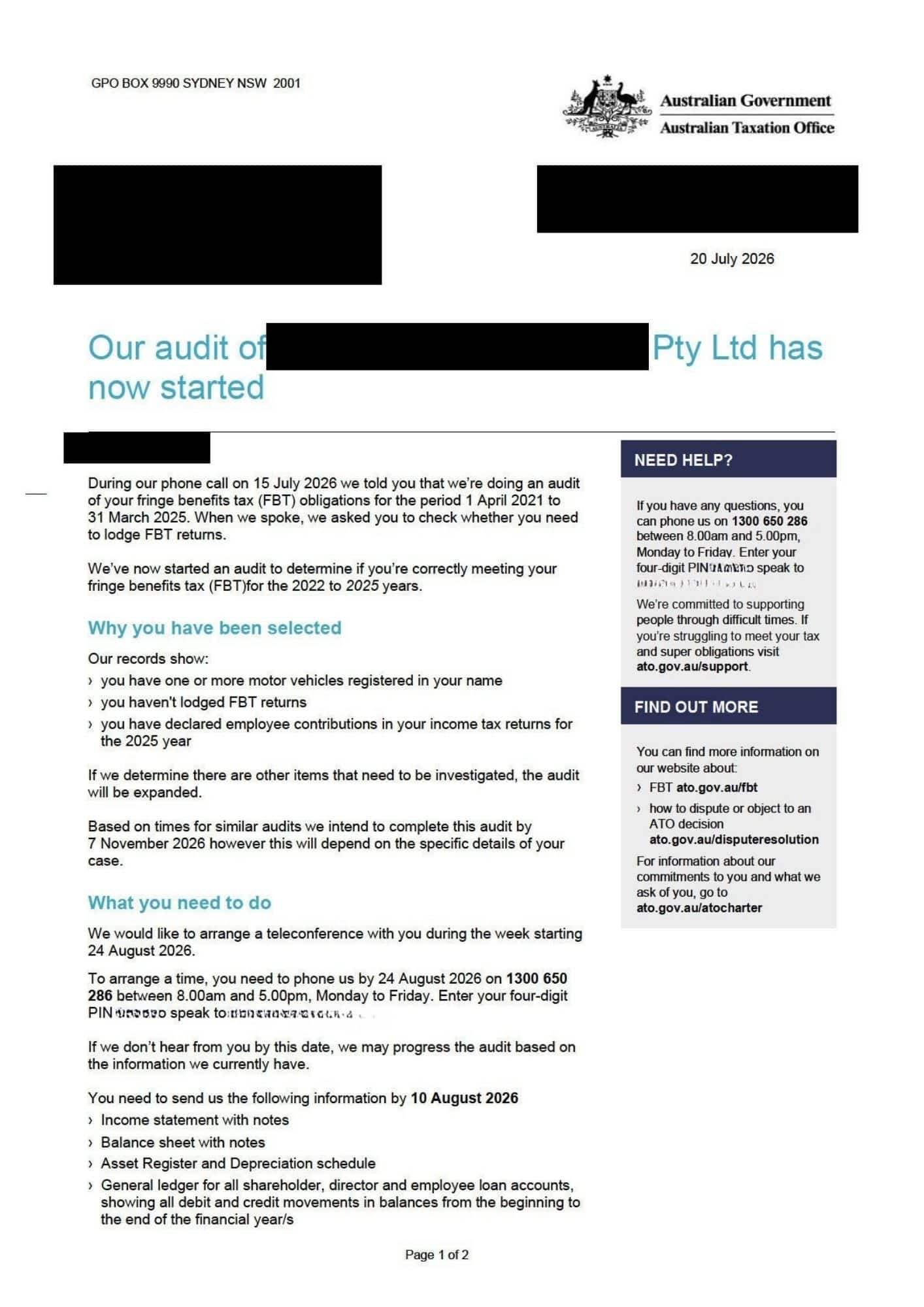
This isn’t a rumour or a scare campaign. It’s a real, active ATO project and we’ve attached some examples of letters below that have come across our desk from concerned new clients that have wanted us to represent them during these audits.
If you own a work vehicle in your business or trust beware – the ATO is watching….it’s not just sedans that they are focusing on, they are focusing on utes too!
What’s actually happening?
The ATO has identified businesses that own vehicles and is writing to ask them to reconsider their FBT compliance before they begin an audit. These letters carry a project reference number, which tells us this is part of a broader compliance campaign rather than a one-off audit of a single business. That’s actually useful to know because it means the ATO is working from data matching across a large number of businesses and it’s proactively flagging vehicles and businesses it believes are at high risk of getting it wrong.
The letters ask business owners to review their position, work out if FBT is payable and lodge an amendment by a set date. If you ignore it, the risk doesn’t go away, it escalates. A prompt leads to a formal review/ audit once the time to respond elapses.
“But it’s just a work ute… surely that’s exempt?”
This is the single most common misunderstanding we see and the ATO’s letter makes the point directly: dual cab utes are not automatically exempt from FBT. There’s a two-part test, and both parts have not only be satisfied but you will need to prove that you have met the ATO’s requirements retrospectively (impossible to prove if in reality you haven’t)!
1. Is it an “eligible vehicle”? Broadly, the vehicle needs to be designed to carry a load of one tonne or more, more than eight passengers, or a load under one tonne but not primarily designed for carrying passengers. Most dual cab utes meet this test, but it needs to actually be checked against the vehicle’s compliance plate, not assumed.
2. Is private use genuinely limited? Even if the vehicle passes test one, the exemption only holds if any private use is minor, infrequent and irregular; think an occasional trip to the tip, not weekend trips to the coast or towing the boat on Sundays. Travel between home and work is generally fine. Regular personal errands, family use, or a vehicle that’s simply available for the employee to use as they please, is not.
If private use goes beyond that limited scope, FBT applies and in full, calculated on the vehicle’s value, not just the “extra” private portion.
And it’s not only utes
The compliance campaign is not only aimed at dual cab utes right now, it is any vehicle owned by a company or trust and made available to a director, employee, shareholder or their family; a sedan, an SUV, a “company car” sits squarely within the ordinary car fringe benefit rules. There’s no equivalent exemption test like there is for a dual cab – if a company or trust-owned car is available for private use, FBT applies, calculated under the statutory formula or operating cost method (but for this method you would have needed to have a valid logbook in place retrospectively).
This is a particularly common blind spot in family-owned and trust-structured SMEs, where a vehicle is bought through the business for tax-effective reasons and then simply becomes “the family car”, often without anyone turning their mind to FBT at all.
And for those thinking of backdating a logbook, think twice. The ATO has many ways to challenge a logbook’s validity and it only takes one trip it can prove happened but isn’t recorded to have the whole logbook rejected. Beyond that, if the ATO believes a director has deliberately falsified records, it can extend the audit period and increase the resulting liability, along with penalties.
Why this matters more than it might seem
FBT exposure isn’t calculated per employee or per “extra” trip (where a logbook cannot be relied upon). It’s calculated on the value of the vehicle itself, for every day it was available for private use during the year. For a business with even a modest fleet, or a family group with a handful of vehicles across a company and a trust, the numbers add up fast. It’s entirely possible for the worst-case liability across a fleet to run into six or seven figures, well before any penalties and interest are added for late or incorrect lodgment.
And critically: the record-keeping obligation exists regardless of whether you believe you’re exempt. Even businesses confident their vehicles qualify need to be able to demonstrate it, with evidence, not just an assumption or a signed form completed after the fact.
What we’re recommending clients do now
- Get a proper vehicle register together with usage records
- Check eligibility properly; don’t assume a ute is exempt
- Implement a limited private use policy
- Look honestly at private use and implement an annual check
- Shore up your evidence; annual odometer declarations & tests
- Act before the ATO acts for you; register for FBT, lodge annual returns
This article is general information only and doesn’t take into account your specific circumstances. If you’d like a confidential review of your vehicle fleet and FBT exposure simply contact us on 1300 878 876 or send us an email to contact@upturn.com.au.